
Some of the strongest hotels are built around one clear idea.
The challenge is choosing which one deserves to lead.
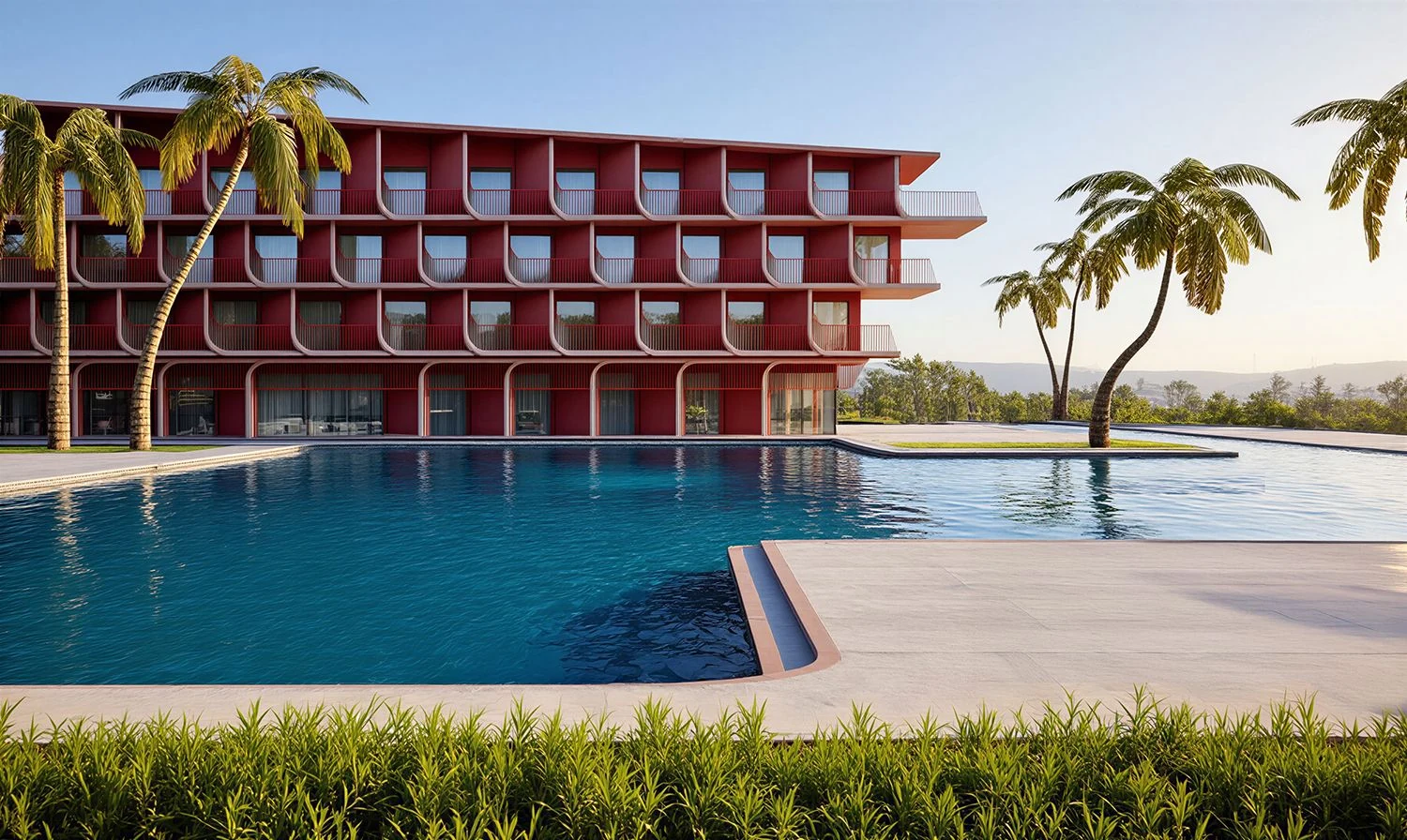
With every hotel project, we make a very conscious decision at the beginning: What is the one aspect we actually want to innovate? Not every space. Not every element. One.
In this case, it is the balcony. We go deep into that one element. We test it, repeat it, adjust it, and turn it into a language that can carry the identity of the building.
Once that decision is made, it takes center stage. Everything else steps back.
That focus is not an aesthetic preference. It is a hospitality design strategy. It creates a system. The design stays balanced and legible. It supports marketing, construction, and long-term maintenance.
And it does all of that without sacrificing innovation. Innovation is simply placed where it has the most impact.
Restraint is not the absence of ambition. It is ambition with direction.
Hotels suffer when too many elements want attention at the same time. When everything wants to be special. Custom details for the sake of custom details. New geometry because why not. Exceptions turning into the system.
On drawings, this often looks impressive. On site, it becomes a shared trauma. And in a hotel, that confusion multiplies. Across hundreds of rooms. Across repeated details. Across years of operation and maintenance.
Here, innovation is concentrated in one place. Because of that: repetition becomes a strength, not a compromise. the system stays legible. fabrication becomes predictable. tolerances remain manageable.
And the design survives contact with construction without being diluted. This is how a design language is built in hospitality. Not by inventing endlessly, but by committing fully.
Restraint is not the absence of ambition. It is ambition with direction. Successful developments rarely try to reinvent everything. The best hotels are designed with restraint, not excess.